
Warehouse waterproofing involves treating large flat or corrugated roofs, expansion joints, and wall bases with industrial-grade coatings and membranes to protect stored inventory from leaks and moisture damage — a service LCS Chemical Services provides for warehouses, factories, and storage facilities across Karachi.
A leaking warehouse roof isn’t just an inconvenience — it’s a direct threat to whatever is stored underneath, whether that’s raw materials, finished goods, or expensive machinery. With Karachi’s combination of intense heat and heavy monsoon rain, warehouse roofs face constant stress across some of the largest surface areas in the city. This guide covers why warehouses need specialized waterproofing, the methods that hold up at industrial scale, and how to choose a provider who understands the difference between a small residential job and a large commercial facility.
Why Warehouses Need Specialized Waterproofing
Massive Roof Surface Area
Warehouse roofs span thousands of square feet, which means even a small percentage of weak or under-treated area translates into a large total surface vulnerable to leaks.
Corrugated Steel and Metal Roofing
Many Karachi warehouses use corrugated steel sheet roofing rather than flat concrete, which requires a different waterproofing approach since seams, screw fixings, and overlapping panels each present their own leak risk.
Constant Structural Movement
Large industrial buildings experience more thermal expansion and structural flex than smaller residential roofs, putting extra stress on expansion joints and seams across the warehouse structure.
High-Value Inventory at Risk
Unlike a residential leak that damages a ceiling, a warehouse leak can ruin stored inventory, packaging, or equipment, turning a roofing problem into a significant financial loss.
Common Warehouse Waterproofing Problems
Leaking Corrugated Sheet Seams
The overlapping joints between corrugated sheets and the screws holding them in place are common entry points for water, especially once original sealant has aged and dried out.
Expansion Joint Failures
Warehouses built in large sections typically include expansion joints between blocks, and these flexible gaps are among the first areas to fail if not properly resealed over time.
Why Expansion Joints Fail First in Warehouses
Because warehouse structures are larger and experience more thermal movement than residential buildings, the joints designed to absorb that movement are placed under significantly more stress, making them a priority area in any warehouse waterproofing plan.
Wall Base Seepage
Water pooling against exterior warehouse walls, especially near loading docks and drainage points, can seep in at the base of the wall if it isn’t properly sealed.
Skylight and Ventilation Leaks
Skylights and roof ventilation units installed for natural lighting and airflow are common leak points if their surrounding seals aren’t maintained.
Read More:
Finding the Best Waterproofing Sheets for Your Roof
Which Grade Cement is Best for Waterproofing?
Warehouse Waterproofing Methods
Bituminous Membrane for Large Flat Roofs
Torch-applied or self-adhesive bitumen membranes provide a thick, durable barrier well suited to large flat concrete warehouse roofs facing constant sun and rain exposure.
Polyurethane Sealant for Corrugated Sheet Seams
A flexible polyurethane sealant is applied along corrugated sheet overlaps and screw fixings, since it stretches with the metal roofing’s thermal movement instead of cracking like a rigid filler would.
Liquid Applied Membrane for Complex Roof Layouts
For warehouses with skylights, ventilation units, and multiple roof levels, a liquid-applied membrane conforms to irregular shapes and penetrations far more easily than pre-formed sheet systems.
Heat-Reflective Industrial Coating
Given the scale of most warehouse roofs, a heat-reflective top coat can noticeably reduce indoor temperatures, helping protect temperature-sensitive inventory and reduce cooling costs for climate-controlled storage areas.
Choosing Between Coating Systems at Scale
For a roof spanning thousands of square feet, the cost difference between coating systems becomes more significant, so choosing the right balance of durability and budget matters more at warehouse scale than it does for a small residential roof.
The Warehouse Waterproofing Process
Step 1: Full Roof Survey and Risk Mapping
Given the scale involved, a proper warehouse waterproofing project starts with a full roof survey identifying every seam, joint, skylight, and drainage point across the entire structure.
Step 2: Surface Cleaning and Repair
The roof is cleared of debris, and any damaged sheets, cracked joints, or failed sealant are repaired before new waterproofing material is applied.
Step 3: Seam and Joint Treatment
Every corrugated sheet seam, expansion joint, and penetration point is treated individually, since these are the areas most likely to develop leaks first on a large industrial roof.
Step 4: Full Coating or Membrane Application
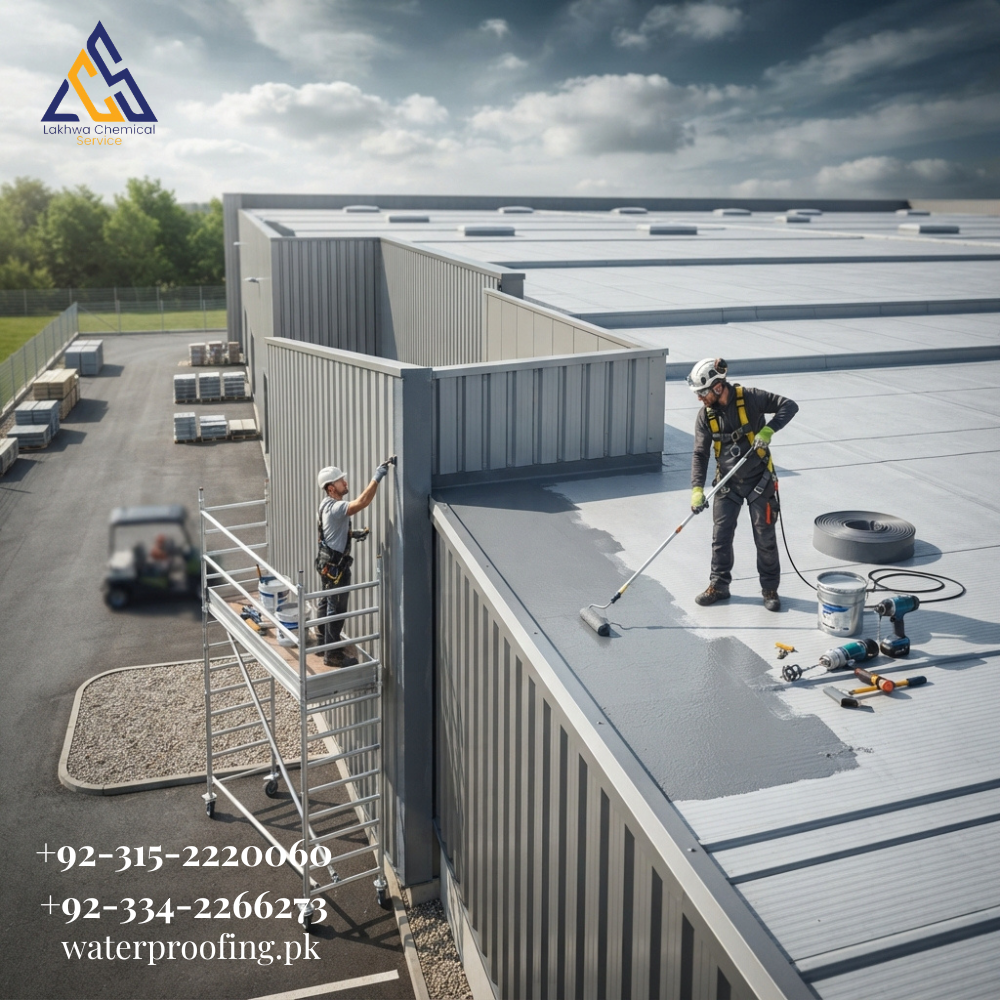
The chosen waterproofing system is applied across the complete roof surface in coordinated sections, ensuring consistent coverage across a much larger area than a typical residential project.
Step 5: Curing and Final Inspection
The completed system is left to cure, followed by a full inspection and, where possible, a water test across different roof sections to confirm no leak points remain.
How LCS Chemical Services Handles Warehouse Waterproofing in Karachi
LCS Chemical Services approaches warehouse waterproofing as a large-scale project requiring careful planning, starting with a full roof survey to map every seam, joint, and penetration point before recommending a treatment system. The team has experience working across both flat concrete warehouse roofs and corrugated steel sheet structures, applying polyurethane sealants to seams and expansion joints while using bituminous or liquid-applied membranes across the broader roof surface depending on the layout. For warehouses storing temperature-sensitive goods, LCS Chemical Services also offers heat-reflective coating as part of the waterproofing package, helping reduce indoor temperature swings across large storage areas.
Choosing the Right Warehouse Waterproofing Company in Karachi
Ask About Experience With Industrial-Scale Projects
A provider experienced with residential roofs isn’t automatically equipped for a warehouse-scale project — ask specifically about past projects of similar size and roof type.
Confirm How They Handle Corrugated Sheet Seams
Since seam and screw-fixing leaks are one of the most common warehouse problems, ask how the provider treats these areas specifically rather than relying on a single blanket coating.
Look for Minimal Disruption to Operations
Warehouse waterproofing often needs to happen without shutting down daily operations, so ask how the provider plans to work around active storage and loading areas.
Frequently Asked Questions
What is warehouse waterproofing? Warehouse waterproofing is the process of treating large industrial roofs, seams, expansion joints, and wall bases with coatings and membranes designed to prevent leaks and protect stored inventory from water damage.
How is warehouse waterproofing different from residential roof waterproofing? Warehouse roofs are much larger, often use corrugated steel rather than concrete, and experience more structural movement, requiring different materials and a more coordinated application process than a typical residential roof.
How long does warehouse waterproofing last? With proper seam treatment and a quality coating or membrane system, warehouse waterproofing typically lasts 5 to 15 years depending on the roof type, materials used, and exposure conditions.
Can warehouse waterproofing be done without stopping operations? In most cases, yes. Waterproofing work can usually be scheduled and sectioned to avoid disrupting active storage and loading areas, though this should be discussed directly with the provider beforehand.
Why should I choose LCS Chemical Services for warehouse waterproofing? LCS Chemical Services conducts a full roof survey before treatment, has experience with both concrete and corrugated steel warehouse roofs, and offers combined waterproofing and heat-reflective solutions suited to large industrial facilities across Karachi.
Warehouse waterproofing carries higher stakes than a typical residential project, since a single leak can damage large volumes of stored inventory rather than just a ceiling. Getting it right means starting with a full roof survey, treating seams and expansion joints individually, and applying a coating system suited to the roof’s scale and material. Working with an experienced provider like LCS Chemical Services ensures a warehouse roof is treated with the planning and precision an industrial-scale project actually requires.
Faqs
1. Why is warehouse waterproofing important?
Warehouse waterproofing helps prevent leaks, dampness, mold, corrosion, and structural damage caused by water and moisture.
2. What areas of a warehouse need waterproofing?
Common areas include roofs, walls, floors, basements, loading bays, joints, expansion gaps, and other areas exposed to water.
3. How long does warehouse waterproofing last?
The lifespan depends on the waterproofing system, materials used, weather conditions, and quality of installation. Professional systems can provide long-term protection.
4. What are the signs that a warehouse needs waterproofing?
Water stains, damp walls, roof leaks, mold growth, peeling coatings, cracks, and standing water are common warning signs.
5. Can waterproofing prevent warehouse roof leaks?
Yes. A suitable waterproofing system can seal vulnerable areas and help prevent water from penetrating the warehouse roof.
6. How do I choose the right warehouse waterproofing solution?
The right solution depends on the warehouse structure, surface condition, water exposure, climate, and specific leakage problems. A professional inspection can help determine the best system.