Foundations are the most critical yet least visible part of any structure — and in a city like Karachi, where high water tables, monsoon rains, and coastal humidity are constant factors, foundation waterproofing is not a luxury, it’s a necessity. Once water penetrates a foundation, the damage often goes unnoticed for years until cracks, dampness, and structural weakening become serious and expensive problems.
Choosing the right waterproofing membrane for your foundation can mean the difference between a building that stands strong for decades and one that requires costly repairs within a few years. In this guide, we’ll break down the best foundation waterproofing membranes available today, how they work, and how to choose the right one for Karachi’s unique soil and climate conditions.
Why Foundation Waterproofing Is Critical in Karachi
Karachi’s coastal location and seasonal rainfall create specific challenges for building foundations that many other cities don’t face to the same degree.
High Water Table and Soil Conditions
Many areas of Karachi have a naturally high water table, meaning groundwater sits closer to the surface than in inland cities. This constant moisture exposure puts continuous hydrostatic pressure on foundation walls and slabs, pushing water inward through even the smallest cracks or gaps.
Monsoon Rainfall and Drainage Issues
Seasonal monsoon rains can overwhelm drainage systems, causing water to pool around building foundations for extended periods. Without a proper waterproofing membrane, this standing water eventually finds its way through foundation walls.
Consequences of Poor Foundation Waterproofing
- Rising damp and mold growth in basements and ground floors
- Corrosion of steel reinforcement, weakening structural strength
- Cracking and spalling of concrete over time
- Reduced property value and costly long-term repairs
What Is a Waterproofing Membrane?
A waterproofing membrane is a continuous layer of water-resistant material applied to a foundation’s exterior or interior surface to block moisture penetration.
How Membranes Protect Foundations
Membranes work by creating a physical barrier between the soil (and the moisture within it) and the concrete foundation. Depending on the type, they may be rigid, flexible, sheet-based, or liquid-applied, but the goal is always the same: stop water before it reaches the structure.
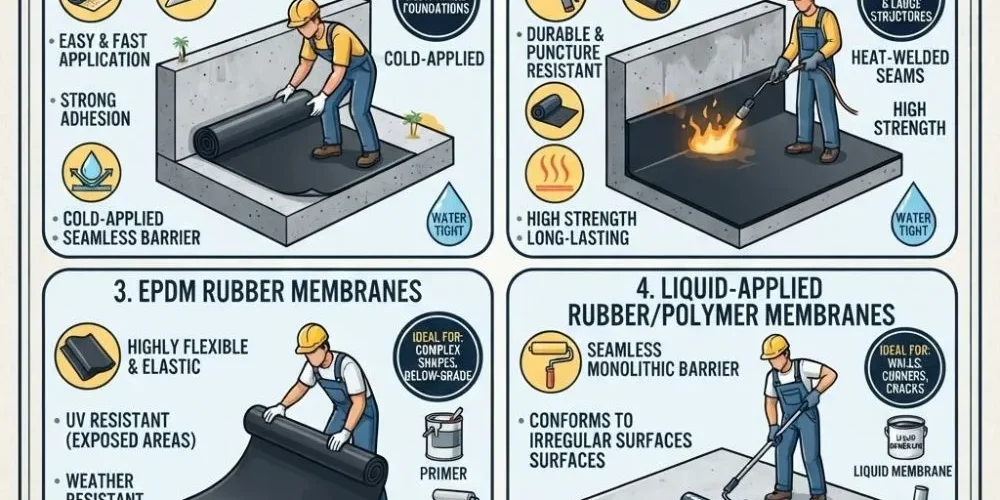
Types of Foundation Waterproofing Membranes
There isn’t a single “best” membrane for every project — the right choice depends on soil conditions, budget, and whether the foundation is new construction or an existing structure needing repair.
1. Bituminous Membrane
One of the oldest and most widely used foundation waterproofing solutions.
How It Works
Bituminous membranes come in two main forms: torch-applied sheets and liquid-applied bitumen coatings. Both create a thick, durable waterproof layer resistant to hydrostatic pressure.
Best For
- New construction foundations
- Basements and retaining walls
- Projects requiring a cost-effective, long-lasting solution
2. Liquid-Applied Membrane
Liquid membranes are applied directly onto the foundation surface using a roller, brush, or spray, curing into a seamless, flexible waterproof coating.
How It Works
Because there are no seams or joints, liquid membranes eliminate the weak points that sheet membranes can sometimes have at overlaps. Many formulations also remain flexible enough to accommodate minor structural movement without cracking.
Best For
- Irregularly shaped foundations
- Retrofitting existing buildings
- Areas prone to minor ground shifting
3. Cementitious Waterproofing Membrane
A cement-based waterproofing compound, often enhanced with polymer additives, applied directly onto concrete surfaces.
How It Works
This membrane bonds chemically with the concrete, filling pores and micro-cracks to create a dense, water-resistant surface. It’s particularly effective when combined with bonding agents like SBR (Styrene Butadiene Rubber) latex, which significantly improve adhesion and reduce the risk of future cracking.
Best For
- Foundation walls and slabs
- Wet areas and retaining structures
- Renovation and repair projects
4. Sheet Membrane (HDPE/PVC)
Pre-manufactured sheets made from high-density polyethylene (HDPE) or PVC, installed by welding or overlapping seams.
How It Works
These sheets offer excellent puncture resistance and are highly effective in areas with severe hydrostatic pressure, such as basements below the water table.
Best For
- Deep basements
- High water table areas
- Large commercial foundations
5. Crystalline Waterproofing
A less common but highly effective method where a chemical compound is applied to concrete, reacting with moisture to form crystals that block water pathways within the concrete itself.
How It Works
Unlike surface membranes, crystalline waterproofing works from within the concrete, making it self-healing to some degree — if new micro-cracks form, moisture triggers further crystal growth to reseal them.
Best For
- Foundations where surface membranes are impractical
- Long-term, low-maintenance waterproofing
- Structures with a history of minor cracking
Choosing the Right Membrane for Your Project
Key Factors to Evaluate
- Water table level – Higher water tables typically call for sheet membranes or crystalline systems designed to withstand constant hydrostatic pressure.
- New construction vs. retrofit – New builds have more flexibility in membrane choice, while existing structures often benefit from liquid-applied or cementitious systems that don’t require excavation.
- Soil type – Expansive or shifting soils favor flexible membranes over rigid ones.
- Budget and lifespan – Bituminous and cementitious systems are generally more affordable, while sheet and crystalline systems offer longer-term performance at a higher upfront cost.
- Application conditions – Some membranes require dry surfaces and specific temperatures for proper curing, which affects scheduling around Karachi’s rainy season.
Why Professional Installation Matters
Foundation waterproofing is a one-chance job in many cases — once a building is backfilled or a slab is poured, correcting a poorly applied membrane becomes extremely costly. Proper surface preparation, correct product selection, and precise application technique are just as important as the membrane material itself.
This is where experienced providers make a measurable difference. Lakhwa Chemical Services offers professional foundation waterproofing solutions tailored to Karachi’s specific soil and climate challenges. Their approach focuses on selecting the right membrane system for each project’s water exposure and structural requirements, ensuring foundations stay protected against rising damp, hydrostatic pressure, and long-term moisture damage.
Final Thoughts
A foundation is only as strong as its protection against water, and in a city like Karachi, that protection needs to account for high water tables, seasonal rainfall, and variable soil conditions. Whether you choose a bituminous membrane, liquid-applied coating, cementitious system, sheet membrane, or crystalline waterproofing, the right decision depends on your specific site conditions and long-term goals for the structure.
Consulting with a specialist like Lakhwa Chemical Services before construction or renovation begins can help ensure your foundation gets the right waterproofing membrane the first time — saving significant repair costs and structural headaches down the road.
A well-protected foundation today means a stronger, drier building for decades to come.
Faqs
1. What is a foundation waterproofing membrane?
A foundation waterproofing membrane is a protective layer applied to foundation walls to prevent water, moisture, and dampness from entering a building.
2. Why is foundation waterproofing important in Karachi?
Foundation waterproofing helps protect buildings from groundwater, soil moisture, heavy rain, and dampness that can cause cracks, mold, and structural damage.
3. What types of foundation waterproofing membranes are available?
Common options include bituminous membranes, PVC membranes, HDPE membranes, and liquid-applied waterproofing systems. The right choice depends on the site and foundation conditions.
4. How long does a foundation waterproofing membrane last?
A quality membrane can last for many years when properly selected and installed. Its lifespan depends on the material, installation quality, soil conditions, and maintenance.
5. How much does foundation waterproofing cost in Karachi?
The cost depends on the foundation size, membrane type, surface condition, labor, and project requirements. A site inspection is usually needed for an accurate estimate.
6. When should foundation waterproofing be installed?
Ideally, waterproofing should be installed during new construction before the foundation is backfilled. Existing foundations can also be waterproofed using suitable repair and membrane systems.