Karachi’s monsoon season is short but brutal — intense downpours in a matter of hours can expose every weak spot in a roof that seemed fine all year. Add in the city’s relentless summer heat and coastal humidity, and you get a climate that punishes roofs from two directions at once. This is why membrane waterproofing has become the go-to solution for homeowners, builders, and commercial property owners across the city. This guide covers what roofing membranes actually are, which types work best in Karachi’s climate, and how to choose a reliable installer.
What Is Roofing Membrane Waterproofing?
Membrane waterproofing involves applying a continuous, flexible barrier layer over a roof surface to block water penetration completely. Unlike basic paint-on coatings, membranes are engineered to bridge cracks, resist ponding water, and flex with temperature-driven expansion and contraction — a critical feature given Karachi’s wide day-to-night temperature swings.
Why Membranes Outperform Basic Coatings
A standard waterproof coating can crack or thin out over time, especially under direct sun exposure. Membranes, by contrast, are manufactured with consistent thickness and tensile strength, so they maintain a uniform waterproof layer even as the building settles or the concrete beneath shifts slightly.
Common Roofing Problems in Karachi That Membranes Solve
Ponding Water on Flat Roofs
Most residential and commercial buildings in Karachi have flat concrete roofs, which are prone to standing water after heavy rain. Membranes with proper slope integration channel water toward drains instead of letting it sit and seep.
Cracking From Heat Cycling
Concrete expands under Karachi’s summer heat and contracts at night, creating hairline cracks over years. Flexible membranes stretch with this movement instead of splitting.
Salt and Humidity Damage Near Coastal Areas
Areas closer to the coast face accelerated concrete corrosion from salt-laden air. A properly sealed membrane keeps moisture and salt particles from penetrating the slab.
Types of Roofing Membranes Best Suited for Karachi
Different membrane systems suit different roof types, budgets, and building uses. Here’s a breakdown of the most commonly used options.
Bituminous Membranes
Torch-On Bitumen Membranes
Applied using heat to fuse the membrane to the roof surface, torch-on bitumen is one of the most widely used systems in Pakistan due to its strong adhesion and proven track record on flat concrete roofs.
Self-Adhesive Bitumen Membranes
These skip the open-flame application process, making them a safer option for residential jobs or roofs near flammable materials, while still offering strong water resistance.
Liquid-Applied Membranes
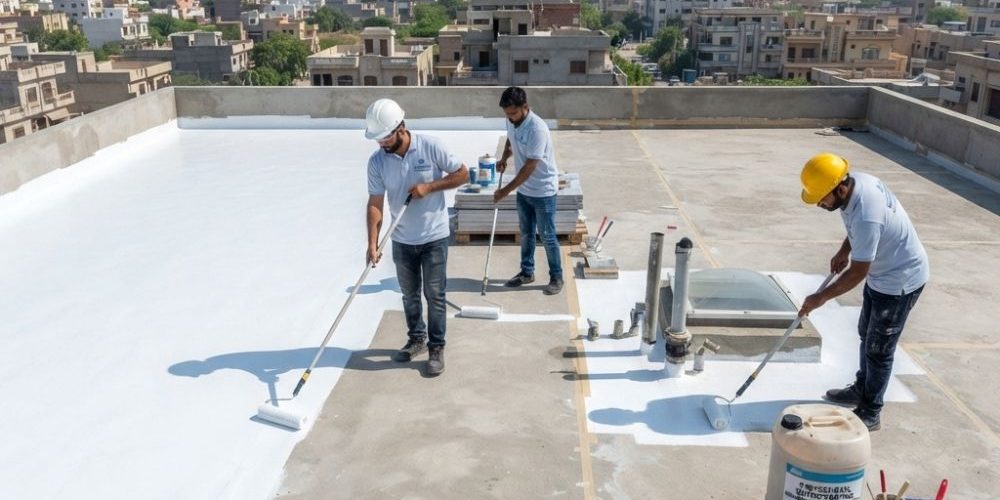
Liquid membranes are rolled or sprayed on and cure into a seamless rubber-like layer. They’re especially useful for roofs with complex shapes, pipes, or protrusions where sheet membranes are harder to fit precisely.
PVC and TPO Membranes
Common in commercial and industrial buildings, these synthetic sheet membranes offer excellent UV resistance and long service life, making them a strong fit for large factory or warehouse roofs exposed to constant sun.
Polyurethane-Based Membranes
Polyurethane systems combine waterproofing with a degree of thermal insulation, which pairs well with Karachi’s need for both heat and water protection in a single application.
Read More:
How Polyurethane Liquid Membrane Provides The Ultimate Roof Waterproofing Solution?
How complicated is the application of the waterproofing membrane in Pakistan?
How to Choose the Right Membrane System
Consider Roof Usage and Foot Traffic
A rooftop used for storage, gatherings, or as a utility area needs a more abrasion-resistant membrane than a purely inaccessible flat roof.
Match the Membrane to Your Budget and Longevity Needs
Short-Term Fixes
Basic bitumen sheet membranes are cost-effective for a 5–7 year lifespan and work well for straightforward rectangular roofs.
Long-Term Investment
PVC/TPO or polyurethane systems cost more initially but often last 12–20 years, reducing the need for reapplication and repeated labor costs.
Ask About Chemical-Grade Waterproofing Providers
Not every contractor works with genuine chemical-grade waterproofing systems — some rely on generic paint-based products marketed as “waterproofing.” Lakhwa Chemical Services is a Karachi-based provider known for chemical-grade waterproofing and membrane application, offering tailored solutions for flat roofs, basements, and water tanks using materials suited to the region’s heat and monsoon exposure. Working with a specialist like this, rather than a general painter or contractor, generally results in a more durable, properly bonded membrane system.
Membrane Comparison Table
| Membrane Type | Best For | Approx. Lifespan | UV/Heat Resistance |
|---|---|---|---|
| Torch-On Bitumen | Standard flat roofs | 5–10 years | Moderate |
| Self-Adhesive Bitumen | Residential, safety-sensitive sites | 5–8 years | Moderate |
| Liquid-Applied | Roofs with pipes/irregular shapes | 6–10 years | Good |
| PVC/TPO Sheet | Commercial/industrial roofs | 12–20 years | Excellent |
| Polyurethane | Combined heat + water protection | 8–12 years | Very Good |
The Membrane Installation Process
Step 1: Roof Survey and Moisture Testing
Technicians check for existing dampness, drainage slope, and structural condition before recommending a membrane type.
Step 2: Surface Cleaning and Repair
All loose debris, old coatings, and cracks are cleared and patched to create a stable base layer.
Step 3: Primer Coating
A bonding primer is applied to help the membrane adhere fully to the concrete substrate.
Step 4: Membrane Application
Depending on the system chosen, sheets are torched, rolled, or sprayed on in overlapping layers to eliminate seams and gaps.
Step 5: Edge Sealing and Drain Integration
Special attention goes to roof edges, parapet walls, and drain outlets — the most common failure points if left improperly sealed.
Step 6: Final Quality Check
A completed installation includes a water-flow test to confirm drainage works correctly and no low spots trap standing water.
Signs Your Roof Needs Membrane Waterproofing
Visible Water Stains on Ceilings
Brown or yellow patches on interior ceilings almost always indicate water is penetrating from above.
Peeling Paint or Bubbling Plaster
Trapped moisture pushes against interior wall finishes, causing bubbling or peeling long before a leak becomes visible.
Musty Odors in Top-Floor Rooms
A persistent damp smell, especially after rain, usually points to slow-seeping moisture within the roof slab.
Frequently Asked Questions
How long does roofing membrane waterproofing last in Karachi?
Depending on the membrane type and installation quality, systems typically last between 5 and 20 years, with PVC/TPO and polyurethane options lasting longest.
Is membrane waterproofing better than regular waterproof paint?
Yes, in most cases. Membranes provide a continuous, engineered barrier with crack-bridging flexibility, while paint-based coatings tend to thin and crack faster under Karachi’s heat cycles.
Can membrane waterproofing be combined with heat proofing?
Yes — several membrane systems, particularly polyurethane-based ones, offer both waterproofing and a degree of thermal insulation in a single application.
What is the best time of year to install roofing membranes in Karachi?
Dry months before monsoon season, typically spring through early summer, are ideal since membranes need dry conditions to bond and cure properly.
Final Thoughts
Choosing the right roofing membrane depends on your roof’s shape, usage, and how long you want the protection to last. For most Karachi properties, a combination of proper surface preparation, a quality membrane system, and correct edge/drain sealing makes the biggest difference in long-term performance. Specialized providers such as Lakhwa Chemical Services, who focus specifically on chemical-grade waterproofing rather than general painting work, tend to deliver more consistent, lasting results. Always request a site survey, ask for a written warranty, and compare membrane types before committing to ensure your roof stays dry through every monsoon season ahead.