Professional expansion joint treatment in Karachi involves resealing the flexible gaps between concrete slabs, roofs, and structural sections using specialized sealants and waterproofing compounds that accommodate building movement while permanently stopping water seepage — a service Lakhwa Chemical Services provides across residential, commercial, and industrial properties throughout the city.
Expansion joints are one of the most overlooked parts of a building, yet they’re often the very first place water finds its way in. Karachi’s combination of intense summer heat, monsoon rains, and constant structural movement puts these joints under more stress than almost any other part of a building. This guide covers what expansion joint treatment actually involves, why it matters so much in Karachi’s climate, and how to choose the right team for the job.
What Is Expansion Joint Treatment?
The Purpose of an Expansion Joint
Every large concrete structure — roofs, parking decks, bridges, and multi-story buildings — is built with intentional gaps called expansion joints. These gaps allow the structure to expand and contract with temperature changes and settle slightly over time without the concrete cracking under the pressure.
Why These Joints Need Special Treatment
Because expansion joints are designed to move, they can’t simply be filled with rigid concrete or standard grout. They need flexible sealants and waterproofing systems that stretch and compress along with the joint, while still keeping water from finding its way through the gap.
Why Expansion Joint Treatment Is Essential in Karachi
Karachi’s Climate Puts Constant Stress on Joints
Karachi’s summer heat regularly pushes rooftop surface temperatures well above 50°C, causing concrete to expand significantly during the day and contract again at night. Over years of this daily cycle, untreated or poorly sealed joints widen, crack, and lose their ability to keep water out.
Monsoon Rains Expose Weak Joints Immediately
When Karachi’s monsoon season hits, expansion joints are usually the first point of failure on a roof or terrace. Water collects directly along these gaps, and even a small failure in the joint sealant can let significant volumes of water into the structure below.
Untreated Joints Lead to Structural Damage
Water that seeps through a failed expansion joint doesn’t stay at the surface — it travels into the concrete slab, corrodes embedded reinforcement steel, and can eventually compromise the structural integrity of the building. What starts as a small leak at a joint can turn into a major repair bill if left untreated.
Read More:
Benefits of expansion joint treatment
How to find the right Expansion Joint Treatment companies for your need
Protecting Interiors and Reducing Repair Costs
Beyond structural concerns, leaking expansion joints cause ceiling stains, damp walls, and damaged interiors in the floors below. Addressing the joint directly is far cheaper than repeatedly repainting ceilings or replacing damaged flooring caused by recurring leaks.
Types of Expansion Joint Treatment Methods
Polyurethane Sealants
A flexible, highly elastic sealant that bonds strongly to concrete edges and stretches with the joint’s natural movement, making it one of the most common choices for rooftop and terrace expansion joints in Karachi.
Silicone-Based Sealants
Known for excellent UV resistance and long-term flexibility, silicone sealants are often used on exposed joints that face direct, prolonged sun exposure throughout Karachi’s long summer.
Bituminous Joint Fillers
A cost-effective option for larger joints, bituminous fillers provide strong water resistance and are commonly paired with a protective membrane strip laid directly over the joint line.
Preformed Joint Strips with Membrane Cover
For high-movement joints, a preformed compressible strip is inserted into the gap and covered with a waterproof membrane strip bonded to the surrounding concrete for a fully sealed barrier.
Backer Rod and Sealant Combination
A foam backer rod is pressed into the joint first to control sealant depth and prevent three-sided adhesion, then the flexible sealant is applied over it — a detail that extends the life of the seal and is a step some contractors skip.
Signs Your Expansion Joints Need Treatment
Visible Cracking or Hardened Sealant
Cracked, crumbling, or hardened sealant along a joint is one of the clearest signs that the existing treatment has failed and lost its ability to move with the joint.
Water Stains Running Along a Straight Line
Ceiling or wall stains that run in a straight line, rather than a random patch, often trace directly back to a failed expansion joint above.
Standing Water Collecting Along the Joint
If water visibly pools along a rooftop or terrace joint after rain instead of draining away, it’s a strong indicator that the joint needs professional attention before the next monsoon season.
The Expansion Joint Treatment Process
Step 1: Inspection and Joint Assessment
A thorough inspection identifies which joints have failed, how wide the movement gap is, and whether surrounding concrete has already sustained water damage.
Step 2: Removing Old Sealant and Preparing the Joint
Cracked or detached sealant is fully removed, and the joint is cleaned of debris and old adhesive residue so the new material bonds correctly along its full length.
Step 3: Installing Backer Rod and Applying Sealant
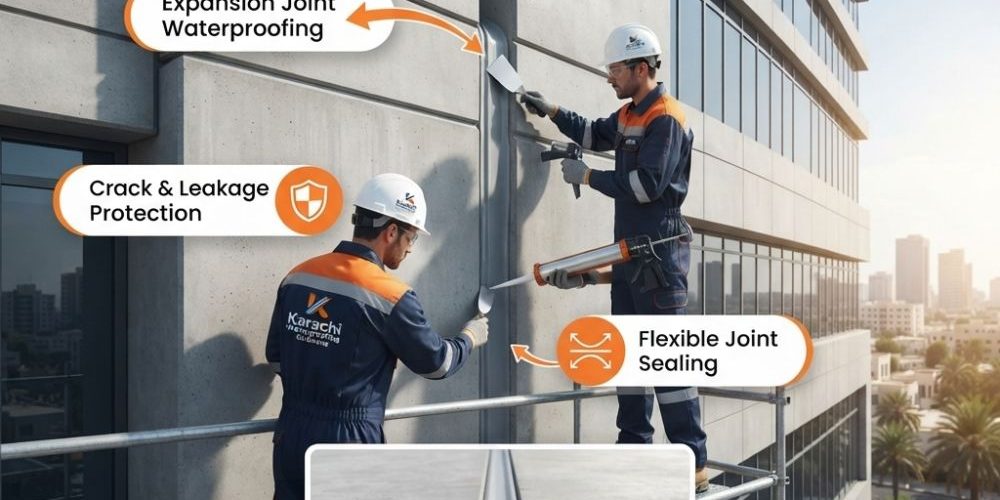
A backer rod is placed at the correct depth, followed by the chosen sealant — polyurethane, silicone, or bituminous — applied evenly along the entire joint line, with a membrane strip added over high-movement joints for extra protection.
Step 4: Curing and Final Inspection
The treated joint is left to cure fully, followed by a final inspection — often including a water test — to confirm the seal is complete before the area is returned to use.
How Lakhwa Chemical Services Handles Expansion Joint Treatment in Karachi
Lakhwa Chemical Services has built its reputation on getting the details right in expansion joint treatment — the exact detail that separates a joint seal that lasts one monsoon season from one that lasts for years. The team carries out a full inspection before recommending a treatment method, uses backer rod and sealant combinations rather than shortcuts, and selects materials suited to Karachi’s specific heat and rainfall patterns rather than a one-size-fits-all approach. For buildings with multiple joints across large roof or parking areas, Lakhwa Chemical Services also offers combined waterproofing and expansion joint treatment packages, since these two issues are frequently connected on the same structure.
Choosing the Right Expansion Joint Treatment Company in Karachi
Ask About Materials and Method
A reliable contractor should clearly explain whether they’re using polyurethane, silicone, or bituminous sealants, why that choice fits your joint, and whether a backer rod is included — skipping it is a common shortcut that leads to premature failure.
Look for a Warranty and Relevant Experience
A company confident in its work should back the treatment with a written warranty, and should have direct experience with your specific joint type — rooftop, parking deck, or structural block joints each need a slightly different approach.
Frequently Asked Questions
What is expansion joint treatment? Expansion joint treatment is the process of resealing the flexible gaps in a concrete structure with materials that accommodate movement while stopping water from seeping through the joint.
How often does expansion joint treatment need to be redone in Karachi? Depending on the sealant used and exposure to sun and rain, a well-installed expansion joint treatment typically lasts 5 to 10 years before resealing is needed.
Can expansion joint treatment be done during the monsoon season? It’s best carried out before the monsoon season begins, since the sealant and membrane materials need dry conditions to bond and cure properly.
Is expansion joint treatment needed for residential homes, or just commercial buildings? Both. While large commercial roofs and parking structures have more joints, residential rooftops and terraces with expansion joints face the same risk of seepage and need the same level of attention.
Why should I choose Lakhwa Chemical Services for expansion joint treatment? Lakhwa Chemical Services follows a complete, detail-focused process — including backer rod installation and membrane reinforcement where needed — using materials suited to Karachi’s climate, backed by experienced technicians across residential, commercial, and industrial properties.
Final Thoughts
Expansion joints may be small compared to the rest of a building, but they’re often responsible for some of the most persistent and damaging leaks a property owner will face. Getting the treatment right — the correct sealant, a backer rod, and proper curing — makes the difference between a seal that fails within a season and one that holds up through years of Karachi’s heat and monsoon rains. Working with an experienced provider like Lakhwa Chemical Services ensures that detail isn’t overlooked.
Faqs
1. What is expansion joint treatment?
Expansion joint treatment is a waterproofing process that protects building joints from water leakage, cracks, and moisture damage.
2. Why is expansion joint waterproofing important?
It helps prevent water from entering through movement joints and protects concrete, walls, ceilings, and other structural areas from moisture-related damage.
3. Where are expansion joint treatment services required?
They are commonly required in roofs, basements, parking areas, concrete structures, commercial buildings, and other areas exposed to water or structural movement.
4. How do you repair leaking expansion joints in Karachi?
The treatment depends on the condition of the joint. Professionals inspect the area, prepare the joint, and apply suitable sealing and waterproofing materials.
5. How long does expansion joint treatment last?
The service life depends on the joint’s movement, exposure, materials used, and quality of installation. Proper preparation and professional application can improve durability.
6. Can expansion joint treatment prevent future water leakage?
A properly designed and installed treatment can significantly reduce the risk of water leakage while allowing the joint to accommodate normal building movement.